


Cart
0
When radios work outside but struggle in stairwells, basements, or upper floors, buying a more powerful transmitter is not a complete coverage plan. Start by identifying the communication path that fails: portable-to-portable, portable-to-repeater, or portable-to-the responding agency’s network.
This guide compares four approaches to professional-radio coverage: portable repeaters, fixed repeaters, building distributed antenna systems (DAS), and base station amplifier systems. They solve different problems, and sometimes work together. For public-safety coverage, involve the radio system licensee, a qualified RF system designer, and your authority having jurisdiction (AHJ) before selecting equipment. No product purchase or checklist alone establishes code compliance or acceptance.
Start with the coverage goal, not the equipment
Write down who needs to talk to whom, on which channels, and from which locations. Separate an internal facilities or security radio network from emergency-responder access to an agency network. A solution for one is not automatically suitable for the other.
Arrange a baseline survey using representative subscriber radios and an agreed test method. Map failures by floor and room, including stairwells, parking levels, service areas, and other locations identified by the AHJ. Check both directions of the call: hearing the base or repeater does not prove a portable can talk back.
Quick selection table
Use this table to frame a design conversation, not as an equipment approval or a substitute for a site survey. “Base station amplifier” here means an amplifier associated with a base radio, not a building-wide bidirectional amplifier (BDA).
| Selection factor | Portable repeater | Fixed repeater | Building DAS | Base station amplifier system |
|---|---|---|---|---|
| Environment | Temporary sites, incidents, events, changing work areas | Permanent facilities or campuses with a suitable antenna site | Multi-floor buildings, basements, stairwells, shielded interiors | A fixed radio position with a specifically identified RF-path limitation |
| Coverage goal | Extend a compatible local radio network from a deployable position | Provide a stable relay point for a compatible radio network | Distribute an approved radio signal through indoor antennas | Increase a base transmitter’s output within an engineered system; not a complete indoor distribution solution |
| Band | Match the exact radio band, channels, and operating mode | Select the correct hardware band and network-compatible mode | Design for the specific agency bands, channels, and signal source | Match amplifier band, radio output, operating mode, and system limits |
| Mobility | Deployable; antenna, feed line, and power still need planning | Installed at a permanent site | Installed building infrastructure | Normally part of a fixed installation |
| Power | DC source or suitable battery; verify runtime at expected duty cycle | Site power and an engineered backup arrangement | Power, backup, and monitoring defined by the design and local requirements | Supply sized for amplifier draw, duty cycle, cooling, and backup needs |
| Duplexing | Confirm frequency plan and antenna isolation; do not assume single-frequency operation | Plan transmit/receive separation, duplexer or antenna isolation, and interference control | Engineer uplink/downlink paths; donor-fed systems need adequate donor-to-indoor antenna isolation | Confirm transmit/receive switching or duplexing and protect the receiver |
| Acceptance testing | Test deployed coverage, intelligibility, interference, and runtime | Test both directions of coverage, receiver performance, interference, and backup operation | Agree with AHJ/licensee on grid testing, critical areas, audio quality, RF measurements, alarms, and backup tests | Compare before/after talk-out and talk-back; check distortion, interference, and receiver performance |
1. Portable repeaters: coverage that can move
A portable repeater is worth considering when the work area changes or a temporary relay point is needed. Its usefulness depends on placement, antennas, terrain and building obstructions, compatible radios, and a suitable frequency plan. Compact equipment is easier to deploy, but it does not eliminate site engineering.
The Hytera HR652 compact DMR repeater is a candidate for compatible UHF deployments. Our listing specifies 400–470 MHz, analog and digital operation, two simultaneous digital voice paths, DC power, and an optional battery. It also lists a licensed single-frequency repeater feature. Confirm the required operating mode, feature licensing, antenna arrangement, programming, and battery configuration before ordering.
A portable repeater is not, by itself, proof of permanent high-rise emergency-responder coverage. Treat it as one possible tool for a defined radio network and deployment.
2. Fixed repeaters: a permanent relay point
A fixed repeater suits a permanent professional-radio network when a survey and RF design support a central relay location. Antenna height and placement, feed-line losses, receiver performance, isolation, and backup power matter alongside transmitter output. One rooftop antenna should not be assumed to serve every basement or stairwell.
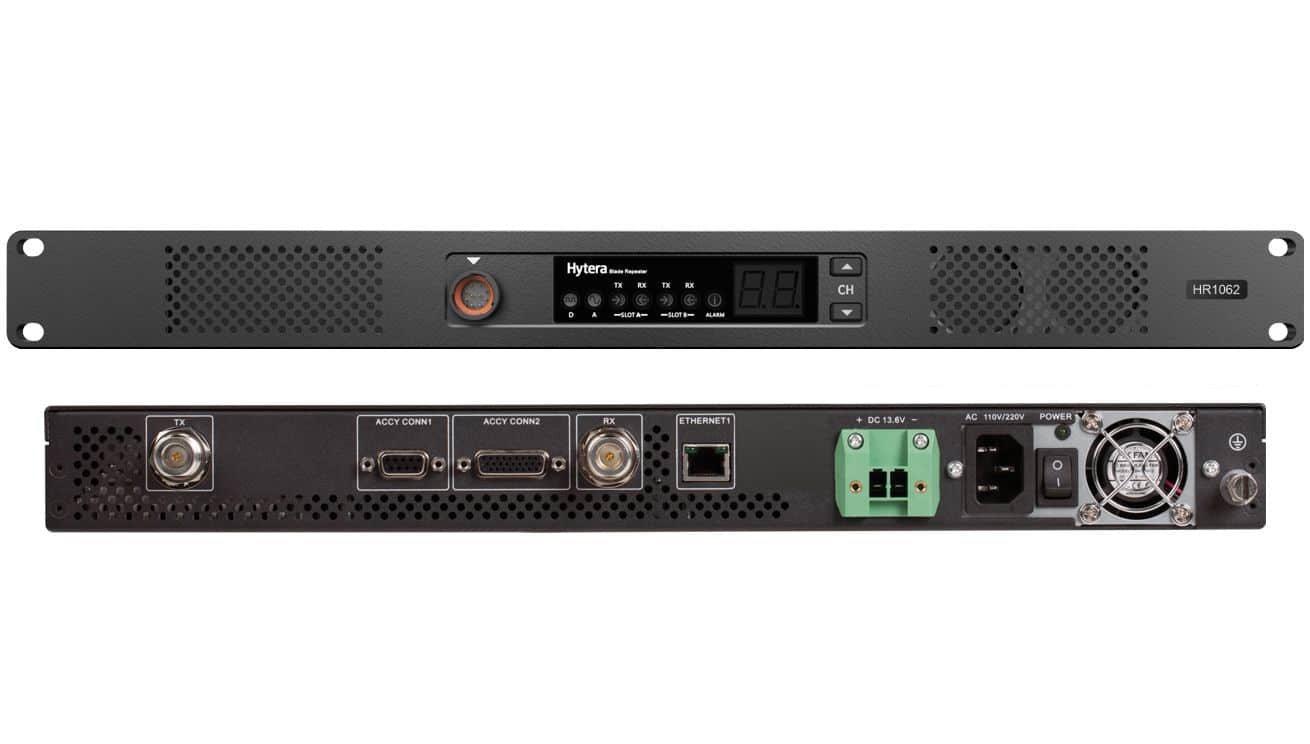
The Hytera HR1062 rack-mounted DMR repeater is an option to evaluate for compatible fixed installations. Our listing describes a 1U form factor, VHF 136–174 MHz and UHF 400–470 MHz versions, analog and digital operation, two simultaneous digital voice paths, and AC/DC auto-switching. Select the correct band version and confirm the exact configuration and accessories.
AC/DC switching is not a complete backup-power design. Specify the battery system, expected operating load, runtime target, monitoring, and maintenance plan separately. Also confirm protocol compatibility: these DMR product descriptions do not establish support for an agency’s P25, trunked, encrypted, or other network requirements.
3. Building DAS: distributing coverage inside
A DAS distributes radio signals through antennas placed within a building. It addresses a different challenge from simply locating one repeater at a better site: getting usable coverage into the places where building construction and geometry obstruct radio paths.
The signal source and distribution design must be selected together. In a donor-fed system, an outdoor antenna receives the network signal and a BDA supports the uplink and downlink paths through the indoor antenna network. Other engineered architectures use different signal sources or distribution arrangements. A DAS and its amplifier are related components, not interchangeable names for a complete approved system.
Donor-fed designs need attention to donor signal quality, antenna isolation, gain, noise, and interference with the serving network. Increasing gain without resolving inadequate isolation can create problems rather than improve coverage. For high-rise public-safety coverage, start with the licensee’s and AHJ’s requirements and a qualified designer’s survey, not a generic amplifier kit.
4. Base station amplifier systems: solve the actual path limitation
A base station amplifier can address a defined transmitter-output requirement in a compatible engineered radio installation. It does not automatically improve the return path from a low-power portable, and it does not place antennas inside shielded rooms. More talk-out power can leave talk-back unchanged.
Before procuring one, ask the designer to identify the limiting path and verify amplifier compatibility, duty cycle, filtering, cooling, antenna and feed-line ratings, and receiver protection. If a vendor uses “base station amplifier” to mean a BDA, clarify the architecture and scope in writing before comparing quotations.
What to put in the procurement request
Provide the building plans, required talk groups or channels, exact bands and operating modes, representative subscriber radios, baseline survey, coverage areas, and intended use. Ask bidders to identify the proposed signal source, coverage assumptions, antenna layout, duplexing or isolation approach, power and backup design, monitoring, installation scope, and maintenance responsibilities.
Require a written acceptance plan before purchase. Agree on test locations, critical areas, both communication directions, audio-quality evaluation, applicable RF measurements, interference checks, backup tests, documentation, and who witnesses and accepts the results. For public-safety installations, obtain the specific criteria from the AHJ and coordinate with the radio system licensee. Do not borrow a passing threshold from another jurisdiction.
The practical choice
Consider a portable repeater for a temporary compatible network, a fixed repeater for a permanent relay site, and an engineered DAS when coverage must be distributed through difficult indoor spaces. Consider a base station amplifier only after identifying a problem that added base transmitter output can actually solve.
For compatible DMR projects, compare the HR652 for compact deployment with the HR1062 for a rack-based installation. Neither listing establishes suitability for a particular emergency-responder network or building acceptance requirement. Confirm the complete system design before procurement.
Further reading
- CISA: Infrastructure Obstructions to Radio Propagation
- Safer Buildings Coalition: AHJs and Licensees
- Safer Buildings Coalition: Grid Testing
Editorial notes for merchant review — remove before publishing
Outline: Define the failed communication path; compare four architectures in a selection table; explain portable and fixed repeater use cases with HR652 and HR1062 links; distinguish building DAS/BDA from base transmitter amplification; finish with procurement and acceptance-testing guidance.
Internal links: HR652 and HR1062 product pages are linked within their relevant sections and the closing comparison.
Featured-image brief: Create a clean professional cutaway illustration of a multi-story commercial building showing a basement, stairwell, rooftop donor antenna, and distributed indoor antennas. Beside the building, show generic compact and rack-mounted repeater silhouettes as distinct options, not a wiring diagram. Use restrained navy, gray, and safety-orange accents. Avoid agency insignia, certification marks, unsupported coverage percentages, or any implication that the pictured equipment guarantees emergency coverage. Suggested alt text after artwork review: “Conceptual comparison of portable repeaters, fixed repeaters, and distributed indoor radio antennas in a multi-story building.” No featured image has been added.